





Open-source technology brings a world that laws and regulations are not quite prepared for. As a result, every now and then, open projects need to work around governmental regulations. In today’s news, KrakenRF team has stumbled into an arms-trafficing legal roadblock for their KrakenSDR-based passive radar code, and is currently figuring it out. There’s no indication that there’s been any legal action from the USA government – the team’s being proactive, as far as we’re told.
KrakenSDR hardware, to simplify it a lot, is five RTL-SDRs on one PCB – with plenty of work put in to do it the right way. It gets you much further than a few dongles – there’s shielded case, suitable connectors, reliable power distribution, a proper USB hub, and importantly, receiver synchronization hardware. Naturally, there’s nice things you can build with such a hefty package – one of them is passive radar, which was a prominent selling point on both KrakenSDR’s pre-launch page back in 2021, and on their crowdfunding page just a week ago. How does that work?
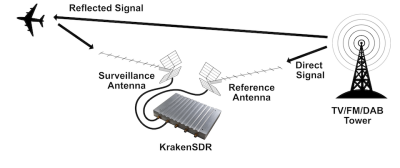 There’s RF emissions floating around you in the air, unless you’re at sea or in the desert. Whether it’s airplane transponders, cell towers, or a crappy switch-mode PSU, the radio waves emitted interact with objects all around you. If you have multiple receivers with directional antennas, you can catch waves being reflected from some object, compare the wave reflected wave to the wave received from the initial source, and determine the object’s properties like location and speed. If you’d like to know more, IEEE Spectrum has covered this topic just a week ago, and the previously-deleted KrakenSDR wiki page has more details for you to learn from.




More Stories
Via AMSAT: ANS-284 AMSAT News Service Weekly Bulletins
via the ARRL: eBay Restricts Listings of Radio Equipment, but Exempts Ham-Band-Only Gear
via the ARRL: The ARRL Solar Update