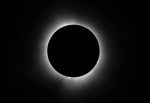



Minutes after totality swept past Cleveland on April 8, 2024, Laura Schwartz and Maris Usis leaned over a laptop on the roof of Case Western Reserve University’s Glennan Building. Data from receivers hundreds of miles away were streaming in.
Then a small change appeared in the recorded radio signal.
“It was very exciting,” recalled Usis (CWR ’24; GRS ’25, electrical engineering). “At the very least, it was an early indication that our experiment may have worked.”
Nearby, David Kazdan, MD, PhD (GRS ’92, biomedical engineering), watched the graphs take shape.
“It really was just a magic moment,” said Kazdan, an adjunct professor at the Case School of Engineering and faculty advisor to the Case Amateur Radio Club, W8EDU.
Their experiment had indeed worked. Last year, that small change became part of the scientific record: A peer-reviewed study led by Usis and published in Frontiers in Astronomy and Space Sciences reveals a surprise about where such experiments belong. Coauthors include CWRU students, alumni, staff and faculty—and every volunteer who ran a receiving station, high schoolers among them.
“[The students] found one really fascinating result that I don’t think has been published in the 100-year publication record of radio and eclipses,” Kazdan said. “It’s one of the really great success stories of amateur science and citizen science.”
Read more – Case Western Reserve University: https://bit.ly/3US0r52



More Stories
via Hackaday: Mars Pathfinder: What Really Happened?
Shine Bright for Voyager’s Light‑Day
via Amateur Radio Daily: Bark + SDR: Phone Pushes for Satellite Recordings, Repeater Traffic, WSJT-X Decodes and Long Recordings