






For most people, the Wi-Fi hardware of today provides a perfectly satisfactory user experience. However, technology is ever-evolving, and as always, the next advancement is already around the corner. Enter Wi-Fi 7: a new standard that is set to redefine the boundaries of speed, efficiency, and connection reliability.
Wi-Fi 7 isn’t just another incremental step in the world of wireless tech. It’s promising drastic improvements over its predecessors. But what does it bring to the table? And how does it differ from Wi-Fi 6E, which is still relatively fresh in the market? Read on.
A GLIMPSE INTO WI-FI 7
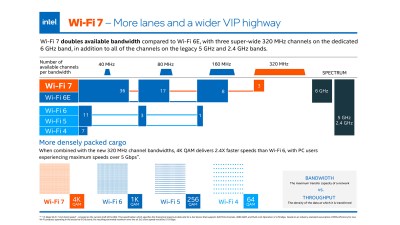
Wi-Fi 7 is recognized in the official naming convention as IEEE 802.11be. It’s headline feature is speed. Wi-Fi 7 is expected to provide speeds up to up to 46,120 Mbit/s. That’s over four times faster than Wi-Fi 6 and 6E, or over 4,000 times faster than 802.11b, the first Wi-Fi standard the world fell in love with. Wi-Fi 7 is also engineered with advanced features to combat latency, bolster capacity, and enhance stability and efficiency. And while it will be backward compatible, like prior Wi-Fi standards, unlocking its full potential will require users to upgrade their devices.
For context, we can compare Wi-Fi 7 with Wi-Fi 6E, its direct predecessor. Both standards utilize the same frequency bands: 2.4 GHz, 5 GHz, and 6 GHz. Yet, Wi-Fi 7 boasts some distinct enhancements.




More Stories
via the ARRL: Florida Hams Provide Communications Support During Hurricane Isaias
Via the RSGB: GB2RS News Script for 18 October 2026
Via AMSAT: ANS-284 AMSAT News Service Weekly Bulletins