





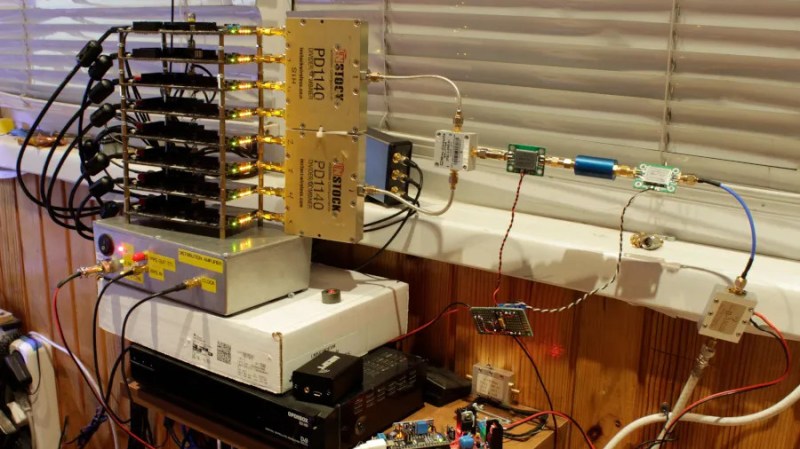
 [Oleg Kutkov] decided to build a wideband SDR – for satellite communication research and monitoring, you know, the usual. He decided on a battery of HackRF boards – entire eight of them, in fact. Two 1×4 and one 1×2 RF splitters and an LNA on their combined RF input made for a good start to the project, and from there, it only got more complex.
HackRF boards can be synchronized with a separate clock source, but you can’t just pull a single clock line to all of them in a star configuration. Thus, he’s built a clock distribution and amplifier board, with 4 ns propagation delay at 1 PPS, and only 10 ns delay at 10 MHz. Then, he integrated that board with the HackRF setup, adding a case, wiring up a purpose-built cable and dealing with the reflections that occurred.
HackRF boards are USB 2.0 and able to generate a stream of data up to 320 MB/s, and there’d be no viable way to aggregate eight 2.0 links into one. To solve that, he’s used eight separate PCI-E to USB 3.0 cards, each of them with one HackRF plugged in, all connected to an AMD Ryzen 9-powered PC through PCI-E risers we typically see used for mining purposes. To tie it all together, he created a gnuradio flowgraph and patched the osmocom source block to enable the external clock synchronization mechanisms he decided to use.



More Stories
via Hackaday: Rare IBM PC Brought Back To Life
via Hackaday: Linux Fu: Heads or Tails for VPN
via Hackaday: Retrotechtacular: A View of the Moon from 1964