
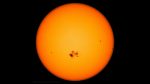


Solar activity has been at low levels this past week with most of the C-level activity originating from Region 4465, including the largest flare of the week, a C2.6 observed on June 10. There are currently 7 numbered sunspot regions on the disk with Region 4467 decaying to plage.
There was a Type-II radio sweep detected by the Radio Solar Telescope Network (RSTN) on June 10. That radio emission was associated with a coronal mass ejection (CME) first observed at the NE quadrant by ground-based coronagraph imagery from HAO/MLSO coronagraph late June 10, and later by space-based coronagraph LASCO/C2. Modeling indicates there is no Earth-directed component.
Other CME activity was observed in the coronagraph imagery later in the period, but preliminary analysis indicated no Earth-directed component. Solar activity is expected to remain at low levels, with a chance for M-class flares and a slight chance for X-class flares. NOAA’s SOLAR-1 satellite became operational early on June 11, becoming the Space Weather Prediction Center’s primary source of solar wind data.
Read more – ARRL: https://www.arrl.org/news/the-arrl-solar-update-33



More Stories
Via the RSGB: The RSGB continues to support young radio amateurs
Via the RSGB: GB2RS News Script for 23 August 2026
via Amateur Radio Daily: 9/11 ‘We Do Remember’ Special Event Returns for 6th Year